



A vial vs. ampoule vs. prefilled syringe comparison starts with what holds the medicine and how the contents are accessed. A typical vial has a separate stopper. A glass ampoule has a fusion-sealed tip and usually opens at a break point on the neck. A prefilled syringe typically holds liquid in its barrel. When that liquid is the medicine, there is usually no transfer from a separate container. The product label tells you what is inside, whether it needs preparation, and how it should be stored.
Vial vs. ampoule vs. prefilled syringe at a glance
These are three forms of primary packaging: the immediate container and the parts that close it. A carton or tray can protect that package and carry instructions, but it is a separate layer. The FDA's guide to container closure systems lists vials, ampoules, and syringes among several presentations for small-volume injectable products.
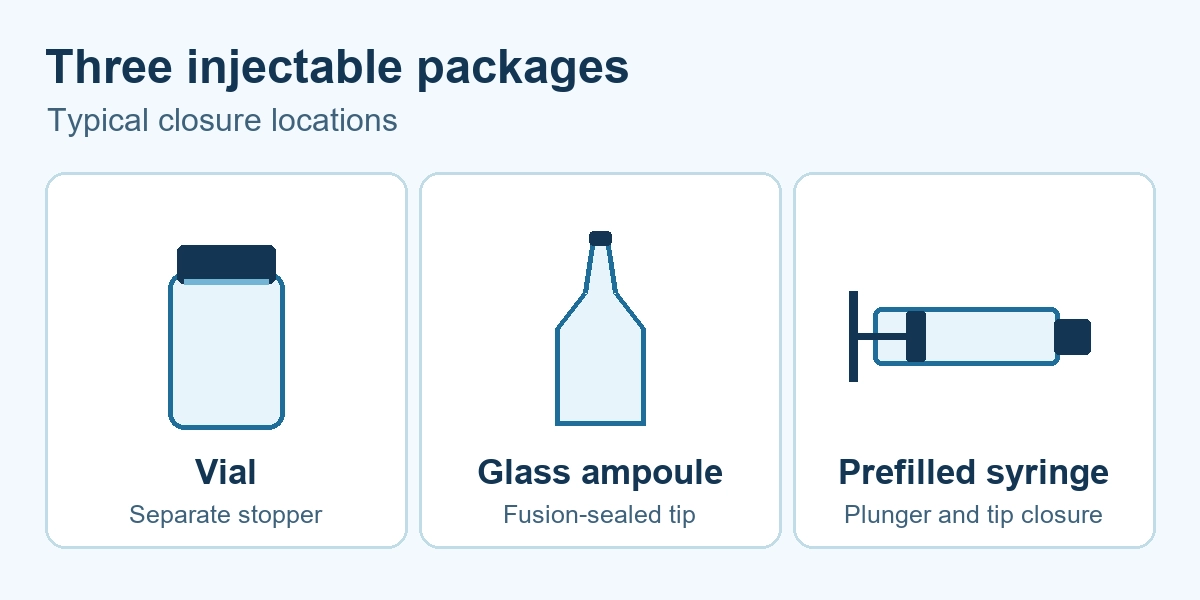
Typical component locations, shown as a schematic. Source: SED Pharma illustration based on the WHO packaging glossary and the FDA container closure guide.
| Format | How it is closed | What differs before use |
|---|---|---|
| Vial | Typically a pierceable stopper, often held in place by a crimped seal. | The medicine is in a separate container. A dry product may need reconstitution before transfer. |
| Glass ampoule | The tip of the finished ampoule is sealed by glass fusion. | The ampoule opens at the neck, commonly at a marked or narrowed point. |
| Prefilled syringe | The barrel is closed by a plunger stopper at one end and a tip cap or needle shield at the other, depending on design. | A medicine already in the barrel usually needs no transfer from a separate vial or ampoule. Other preparation depends on the label. |
How each closure changes access
Vial: a bottle with a separate stopper
On a common injection vial, the stopper closes the opening and a crimped metal seal holds it in position. A flip-off cover, when present, protects the access area over the stopper. This construction can look much the same on a single-dose vial and a multidose vial. The CDC's explanation of vial labeling distinguishes them by their labeled use. Bottle size and the amount of liquid you can see do not tell you which one you have.
A vial may contain a liquid medicine or a dry preparation. Some dry medicines need a specified liquid added before use. For the science behind this presentation, see why some injectable medicines are supplied dry.
Ampoule: a closure made from the container itself
In a conventional glass ampoule, fused glass closes the tip of the finished container. The neck is where the ampoule opens, commonly by breaking at a marked or narrowed point. ISO 9187-1 covers glass ampoules with and without a colored break ring. Health Canada's guidance on sterile drug production identifies both glass and plastic ampoules as examples of containers closed by fusion. The opening design depends on the package.
Prefilled syringe: a container that can also deliver its contents
A prefilled syringe typically holds liquid in a glass or plastic barrel. The plunger stopper seals one end and moves within the barrel. The other end has a closure suited to the design, such as a cap on the tip or a shield over a fixed needle. The ISO overview of prefillable syringes with plastic barrels identifies these as separate components.
A prefilled syringe typically comes with liquid already inside. The label identifies its contents and any preparation needed. For example, one official product label on DailyMed describes a kit with dry medicine in a vial and the diluent in a prefilled syringe. The two containers serve different purposes within the same package.
Why medicines come in different packages
The package has to protect the formulation during storage and fit the way the product is prepared. The FDA packaging guide treats protection, compatibility, safety, and function as properties of the complete container and closure system. A material suitable for one liquid may interact differently with another, and a change in closure can change how the package protects the contents.
The 2023 USP–NF chapter <660> on glass containers describes pharmaceutical glass containers as packaging intended for direct contact with the product.
The format can also change the number of transfers before use. A medicine in a vial or ampoule is kept apart from the device that will deliver it. A prefilled syringe can combine those roles. That can remove one transfer when the syringe already contains the medicine, but it does not establish how the product should be stored or what setup it requires. Those details come from the labeling for that exact product.
What to check when comparing the packages
Start by identifying the immediate container and its closure. Next, read the label to see whether it contains a liquid medicine, a dry medicine, or a separate diluent. Finally, check the product instructions for preparation and storage. The useful takeaway from a vial vs. ampoule vs. prefilled syringe comparison is that the package shape helps you recognize the format; the label explains what that format means for the specific medicine. Ask a pharmacist or the healthcare team if the presentation or instructions are unclear.
Is an ampoule reusable?
A conventional glass ampoule is intended for one occasion. Opening it breaks the original closure. Check the product label for instructions on use and disposal. See the WHO packaging glossary.
Does prefilled always mean ready to inject?
Check what the syringe contains and what the product instructions say about preparation. A kit may contain a prefilled syringe of diluent supplied alongside the medicine in a separate vial. See the DailyMed example.
For pharmaceutical production teams, these differences also determine how each container is filled and closed.
Where the formats meet the filling line
A vial line handles a separate stopper. A glass ampoule line closes the container by fusion, while a prefilled syringe line handles the barrel and its closure components. SED Pharma groups these applications in its injectable equipment range. The photograph below shows the filling and stoppering stage for vials.
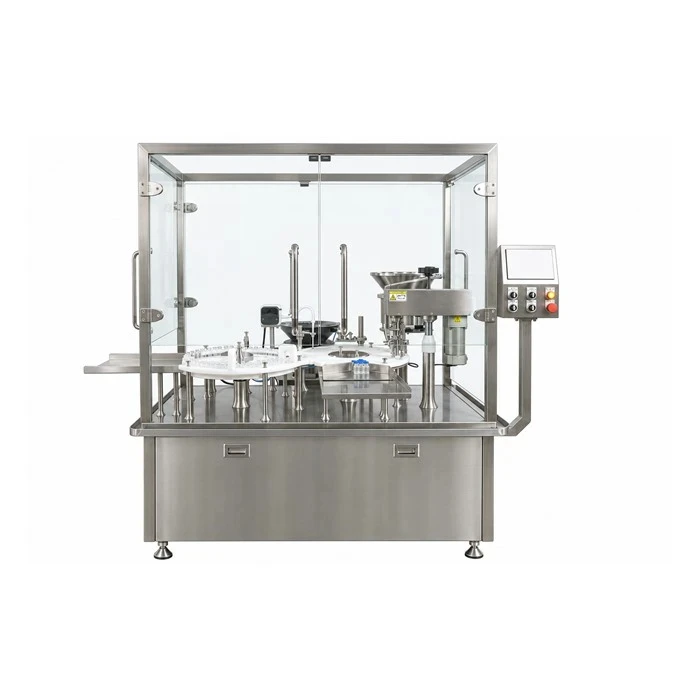
SED Pharma's automatic vial filling machine.
Planning an injectable packaging stage?
If your manufacturing team is planning a filling or closing stage, share the container and closure drawings, how the containers arrive at the line, and which step the equipment needs to handle. Send those details to SED Pharma so the team can discuss where the filling or closing stage fits in your line.