


What is a freeze dryer?
Freeze dryer is a stable process of material dried which will put the material contained with water to freeze to solid first, then make among them of the water sublimate from solid to air condition, removing water to preserve materials. Products at solution stage are frozen through sublimation and desorption, then the solvent reduce to a certain extent, thereby preventing the formation of micro-organisms or chemical reaction between the solute and solvent that products can be preserved for a long time and maintained its nature.
Vacuum freeze-drying method is a liquid → solid → gaseous process. In freeze-drying process, "liquid bridge" between the solution particles has been frozen into "solid bridge". The relative position of particles has been fixed and does not exist surface tension on gas-liquid interface between the two particles. With the continuous distillation of solvent, "solid bridge" continuously decrease, but the the relative position between two particles will no longer change until the "solid bridge" completely disappear.
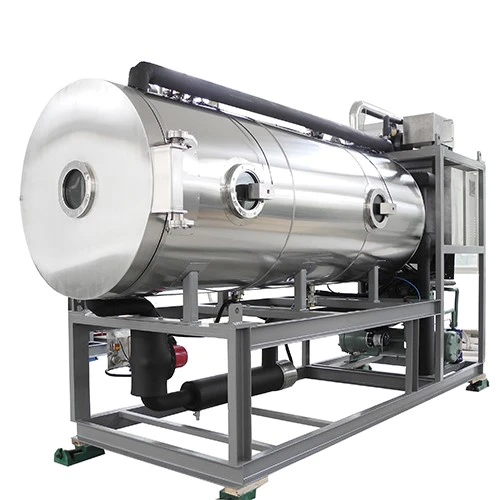
What is the principle of freeze drying machine?
(1) Freezing: After pre-treatment, the substance to be processed is rapidly frozen at low temperature (usually -50 ℃ to -80 ℃), causing the moisture in the substance to solidify and form ice crystals.
(2) Dehydration: Place the frozen substance under vacuum and use the low-temperature Lima cycle heating method to directly sublime ice crystals into water vapor and remove them from the substance. At the same time, external heating can also help evaporate the frozen water in the substance.
3) Drying: After dehydration, continue to maintain a vacuum state to allow the remaining moisture (bound water and free water) in the substance to evaporate, and collect the relatively dry substance. This process is slow and complex, but it can effectively preserve the shape, stability and activity of the sample, and also prevent pyrolysis, oxidation, foam and surface discoloration caused by thermal drying. Therefore, vacuum freeze-drying technology is widely used in fields such as pharmaceuticals, food, and biochemical products.

How to use a freeze dryer?
(Pre freezing - water trap refrigeration - vacuuming - drying)
(1) Place the material tray on the partition of the freeze dryer, ensuring that the material tray and partition are completely overlapped. Place the temperature probe in the middle material tray and fix it with an iron block to reduce the error between the sample temperature and the actual temperature;
(2) Close the door panel, lock the door panel handle, and check if the connection between the drainage valve/inflation valve and the vacuum pump is sealed (the drainage valve/inflation valve should be tightened);
(3) Power on and enter the monitoring interface;
(4) On the monitoring interface, click on "Recipe Management" to enter Recipe Management;
(5) In the formula management interface, the number of segments, temperature and time for each segment can be set to complete the user's freeze-drying program settings; (The freezing temperature cannot be directly set, the machine cools down according to the set time. When materials need to be frozen, the pre freezing time should be at least 2 hours or more.)
(6) Return to the monitoring interface, click on "Operation Control" and then click on "Run" to start the automatic freeze-drying program. The first step is the pre freezing stage. After the pre freezing stage is completed, it will enter the stages of starting the water trap refrigeration, pre vacuuming, and drying (up to 18 stages) in sequence. (In the pre freezing stage or water trap cooling stage, place the material into the material tray after the temperature drops);
(7) When all stages of the freeze-drying process have been completed, it indicates the end of vacuum freeze-drying. Enter the "Operation Control" interface, click "Stop" to turn off the machine, open the inflation valve, and unplug the main power supply. After the air pressure inside and outside the freeze-drying machine chamber is balanced, remove the material as soon as possible.
(8) Open the drain valve and defrost the cold trap through natural ventilation, hair dryer, or by clicking defrost on the control interface. After the water is drained, clean the freeze-drying machine to prepare for the next freeze-drying treatment. Attention: Due to differences in material characteristics and thickness, users should determine the appropriate freeze-drying procedure through experimentation to ensure complete drying of the material* Please cover the exhaust hole when the vacuum pump is not working to prevent dust from entering. Two uses must be separated by 24 hours.
What are the benefits of use lyophilizer?
1. Preserve the original physical and chemical properties
Freeze drying is carried out at low temperatures, which can maximize the preservation of the color, aroma, taste, and nutritional content of food. For example, the natural pigments in vegetables remain unchanged, and the loss of various aromatic substances can be minimized. In addition, freeze-drying is better for preserving protein containing foods than regular freezing.
2. Thoroughly dehydrated and compact in size
The freeze-dried product is lightweight, small in size, occupies less space during storage, and is easy to transport. After various freeze-dried vegetables are compressed, their weight is significantly reduced. Due to the reduced volume, the corresponding packaging costs are also much lower.
3. Easy to rehydrate
Freeze dried solid materials exhibit a porous structure due to the sublimation of tiny ice crystals, and maintain their original frozen volume, making them highly soluble and recoverable when water is added. Compared to other drying methods, freeze-drying technology has unparalleled advantages in maintaining the original physical properties and flavor of products.
4. Protect the activity of thermosensitive substances
Freeze drying is generally carried out at low temperatures and remains in a low-temperature state during the sublimation process, which can greatly protect the activity of substances and is particularly suitable for drying substances such as collagen, vitamins, probiotics, etc.
5. Prevent oxidation and do not require additives
The freeze-drying process is carried out under vacuum conditions, so it has a strong protective effect on substances that are afraid of oxidation, such as vitamin C, anthocyanins, lycopene, etc. And in a low-temperature vacuum environment, microorganisms are not easy to survive, so no food additives are needed to enhance color and flavor, and the shelf life is also longer.
Therefore, freeze-drying technology is an efficient method for drying and preserving food, drugs, and biological products, with multiple advantages such as maintaining their original quality, and being easy to store and transport.
